

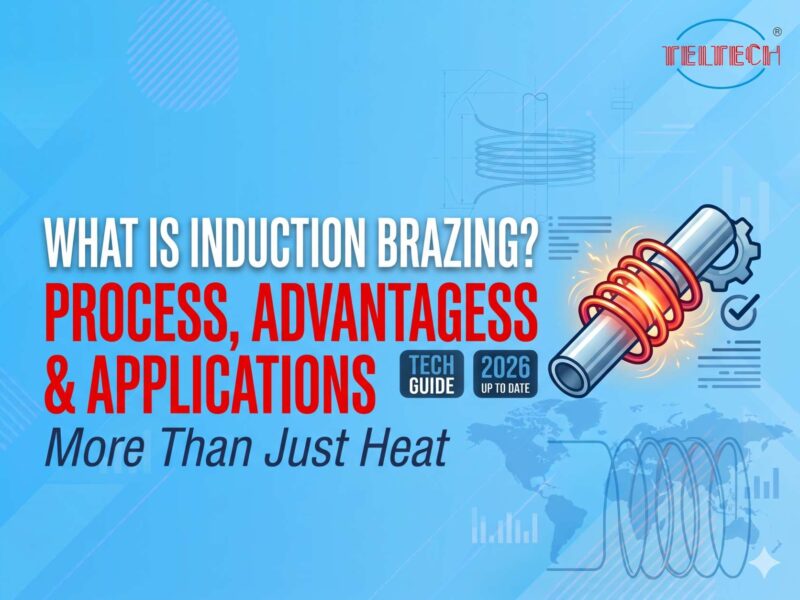
What Is Induction Brazing? Process, Advantages, and Applications
With 25 years of experience partnering with induction brazing manufacturers, we understand how induction brazing utilizes a magnetic field, rather than a flame, to heat the metal parts being joined. The basic premise is simple: a copper coil with an alternating current running through it produces a magnetic field that heats the metal from the inside out, making no direct contact with the part. As the joint heats, a filler metal melts and flows into the thin space between the pieces, cooling and hardening into a strong, sealed bond. Because the filler melts at temperatures over 450°C—staying below the melting point of the parent metals—the parts themselves never melt.
If you’ve ever stood next to a brazing station on a busy shop floor, you know the hard part isn’t making one good joint. It makes the same good joint everyday, all day long. Get the heat wrong and the filler won’t flow. Too much heat, you warp the part, burn the flux, or soften metal that should have stayed hard.
That’s the problem an induction brazing machine is designed to solve.
So what really is going on inside the coil? Three pieces of physics, one after the other.
First, electro-magnetic induction. The coil is supplied with high frequency alternating current and generates a magnetic field that reverses direction thousands of times every second. Secondly, eddy currents. Place a conductive metal object within that field and tiny electrical currents begin to flow through the metal itself.
Third, Joule heating. The metal resists those currents and that resistance becomes heat. Magnetic steels also receive a little bonus heat from hysteresis, at least until they get past their Curie point, around 770°C.
It doesn’t touch anything as the heat starts inside the part and because the field is strongest right where the coil sits, only that one zone gets hot.
Now look at the old method. An operator with an oxy acetylene torch watches the color of the metal and judges by eye when it is ready. No doubt a clever brazer could do as fine work as that. But no two operators braze exactly alike, and even the best have their off days. The flame is a lot hotter than the joint and you’ve got gas cylinders laying around the shop. Modern solid state induction brazing equipment takes a lot of the guess work out of the equation. You set power, frequency and time once. Then part number one and part number ten thousand get the same heat.
How the Induction Brazing Process Works (Step-by-Step)
The induction brazing process looks simple from the outside: load the part, press start, unload a finished joint a few seconds later. But the quality of that joint is decided long before the power switches on. Here’s how it works, step by step.
Step 1 – Surface Preparation & Cleaning
Filler metal won’t wet a dirty surface. Oil, grease, cutting fluid, oxide layers and mill scale all act as barriers that stop the alloy from bonding with the base metal. Parts are usually degreased with a solvent or alkaline wash, and heavier oxides are removed with light abrasion or pickling. It’s the least glamorous step, and it’s where most braze failures quietly begin.
Step 2 – Joint Design, Alignment & Fixturing
Brazing relies on a tight, consistent gap between the two parts. For most silver-based alloys, the ideal joint clearance sits roughly between 0.025 mm and 0.125 mm (0.001″ to 0.005″). Too wide and capillary action weakens; too tight and the filler can’t get in. Fixtures hold the parts in exact alignment so that the gap stays the same on every assembly, and so the joint always sits in the same spot inside the coil.
Step 3 – Fluxing & Brazing Preform Placement
Flux protects the heated surfaces from oxidising and helps the filler flow. Then the filler metal goes in. In production, this is usually a preform: a pre-shaped ring, washer or shim of silver alloy, copper or copper-phosphorus. Brazing paste, which combines flux and powdered alloy, is another popular option for automated lines. Preforms put a measured amount of alloy exactly where it’s needed, which cuts waste and keeps joints consistent.
Step 4 – Electromagnetic Coil Positioning & Energy Delivery
This is where induction heating coil design really matters. The coil is shaped around the joint, often a simple helical coil for tubes, or a pancake, split or channel coil for awkward geometries. High-frequency induction brazing coils concentrate heat near the surface, which is ideal for thin walls and small joints. Lower frequencies push heat deeper into heavier sections. When power is applied, the joint area reaches brazing temperature in seconds.
Step 5 – Capillary Action & Filler Metal Flow
Once the base metal is hot enough, the filler melts and capillary action pulls it through the joint gap, even against gravity. Even heating on both parts matters here. If one side heats faster, uneven thermal expansion can open or close the gap and stop the alloy from flowing. A well-designed coil heats both members evenly, so the filler flows completely and you get full penetration with a neat fillet on the visible side.
Step 6 – Controlled Cooling & Quality Inspection
After the power cuts off, the joint needs to cool in a controlled way. Quenching too early can cause thermal shock, cracks or residual stresses that lead to structural fatigue later. Once cooled, flux residues are washed off and the joints are inspected. Depending on the industry, that might mean visual checks, helium or pressure leak testing, sectioning a sample, or ultrasonic inspection.
Advanced Process Variants: Specialized Induction Brazing Systems
Standard induction brazing in open air, with flux, covers most everyday jobs. But some applications can’t tolerate flux residue or surface oxidation at all. That’s where specialised induction brazing systems come in.
Controlled Atmosphere Induction Brazing (Nitrogen & Argon)
In controlled atmosphere induction brazing, the joint is heated inside a chamber, bell jar or shroud flooded with an inert or reducing gas such as nitrogen, argon, or a nitrogen-hydrogen mix. With oxygen pushed out, the metal surfaces stay bright and clean during heating. This often allows fluxless induction brazing, which means no flux to apply, no corrosive residue to wash off, and no post-braze chemical cleaning. Joints come out clean and ready for the next operation, which is a big plus for components that go straight into assembly.
Vacuum Induction Brazing for Critical Alloys
For the most demanding work, vacuum induction brazing heats the assembly inside a vacuum chamber. Removing almost all gas prevents oxidation and contamination completely, which is essential for reactive and high-performance materials such as titanium, nickel-based superalloys and some stainless steels. The result is a high-purity, void-free joint. That’s why vacuum induction brazing is widely used for aerospace components, medical devices and vacuum electronics, where a single contaminated joint isn’t an option.
Key Advantages of Induction Brazing Over Traditional Methods
Why are so many manufacturers moving away from torches and batch furnaces? The advantages of induction brazing show up in speed, quality, safety and running costs, often all at once.
Ultra-Fast Heating Cycles & Higher Throughput
A batch furnace can take an hour or more to heat up, soak and cool a load. An induction brazing machine typically heats a joint in a few seconds to under a minute, depending on part size. Parts move one at a time through a continuous flow, rather than waiting for a full furnace load. For high-volume lines, that difference translates directly into higher output and less work-in-progress sitting around.
Selective, Localized Heating
Induction is a truly selective, localized heating process. Only the area inside the coil’s field gets hot. Nearby plastic parts, rubber seals, sensors, wiring and previously heat-treated areas stay cool. This also prevents unwanted annealing, so hardened or work-hardened metal keeps its strength right next to the joint. With a torch or furnace, protecting heat-sensitive components is far more difficult.
Consistent Thermal Repeatability & Digital Control
Modern induction systems let you save power profiles as “recipes”: power level, ramp rate, hold time and, with a pyrometer, closed-loop temperature control. Load the recipe and every part receives the same heat cycle. That kind of repeatable braze joint is exactly what Six Sigma and other quality programmes are built around. It also makes process validation, traceability and audits much simpler.
Zero Open Flames & Enhanced Workplace Safety
There’s no flame, no oxygen or acetylene cylinders, and no gas lines snaking across the floor. That eliminates a whole category of fire, explosion and handling hazards. Operators work in a cooler, quieter environment, and there’s less combustion fume to extract. Insurance, compliance and training all tend to become easier as a result.
Extended Fixture Life & Energy Efficiency
Because induction heats only the braze joint interface rather than the entire assembly, far less energy is wasted. There’s no furnace to keep hot between batches and no flame heating the surrounding air. Fixtures stay relatively cool too, so they warp less and last longer. Lower energy use, less scrap and fewer fixture replacements all support a leaner manufacturing operation.
Induction Brazing vs. Torch vs. Furnace Brazing (Comparison)
Each brazing method has its place. Torch brazing is flexible and cheap to start. Furnace brazing handles large batches of complex assemblies. Induction brazing sits in the sweet spot for fast, repeatable, high-volume joints. Here’s how they compare side by side:
| Performance Metric | Induction Brazing | Torch (Flame) Brazing | Furnace Brazing |
|---|---|---|---|
| Heating speed & cycle time | Seconds per joint; continuous one-piece flow | Fast for single joints, but slows with operator fatigue | Slow; long heat-up, soak and cool-down cycles |
| Thermal precision & energy efficiency | Very high; heats only the joint zone | Low to moderate; heat spreads widely | Moderate; heats the whole assembly and furnace |
| Operator skill requirement | Low once the recipe is set | High; depends on brazer’s experience | Moderate; mainly loading and process setup |
| Safety & environmental impact | No flame or fuel gas; low emissions | Open flame, gas cylinders, combustion fumes | High energy use; atmosphere gases to manage |
| Automation & line integration | Excellent; easy to link with robots and PLCs | Limited; mostly manual | Batch-based; harder to fit into an inline flow |
What about induction brazing vs. soldering? Soldering uses fillers that melt below 450°C, while brazing works above that temperature. Brazed joints are much stronger and handle higher operating temperatures and pressures. That’s why refrigeration lines, fuel systems and structural joints are brazed rather than soldered. Induction can be used for both, but brazing is where it really shines.
Key Industrial Applications & Real-World Use Cases
Induction brazing applications span almost every sector that joins metal at volume. Here are the industries where it makes the biggest difference.
HVAC & Refrigeration Manufacturing
This is one of the most common uses. Induction brazing copper pipes, copper-to-brass fittings, valves and aluminum heat exchanger joints gives manufacturers leak-free connections that hold refrigerant under pressure for years. Since a single leaking joint means a warranty claim, the repeatability of induction is a huge advantage on compressor, coil and air-conditioner assembly lines.
Automotive & Electric Vehicle (EV) Systems
Car makers and their suppliers use induction brazing for AC and cooling lines, hydraulic and fuel rail assemblies, and transmission components. In electric vehicles, it’s increasingly used for battery cooling plates and copper busbar connections, where low electrical resistance and consistent joint quality are critical. An automated induction brazing system fits neatly into these high-cadence, robot-driven lines.
Carbide Tooling & Industrial Equipment
Tipping saw blades, drill bits, router bits and mining cutter teeth with tungsten carbide is a classic induction job. The coil heats the steel body and the carbide tip quickly and locally, so the rest of the tool keeps its hardness. Controlled heating also reduces stress cracking in the carbide, which means tools that last longer in the field.
Aerospace & Defense Engineering
Aerospace and defense components demand high-reliability alloy joining under strict ISO, AS and military specifications. Induction brazing, especially in vacuum or controlled atmospheres, delivers clean, traceable joints on fuel lines, hydraulic tubing, sensors and engine components. Digital recipes and data logging make it much easier to meet documentation and qualification requirements.
Selecting the Right Induction Brazing Equipment for Your Production Line
There’s no single “best” induction brazing equipment. The right choice depends on your parts, your volumes and how your line is laid out. A few questions will narrow it down quickly.
Which format suits your work?
- Benchtop units are compact, self-contained systems for workshops, R&D labs and low-to-medium volume production. They’re a practical first step into induction.
- Portable induction brazing heaters have a flexible, handheld or cable-connected heating head. They’re ideal for large assemblies that can’t be moved to a machine, such as HVAC installations, generators, motor windings and on-site repairs.
- Fully automated systems combine the power supply with rotary index tables, conveyors or multi-axis robotic cells. Parts are loaded, brazed, cooled and unloaded with minimal operator involvement. This is where automated induction brazing delivers the biggest gains in throughput and consistency.
What power rating do you need?
Power, measured in kW, determines how much material you can heat and how fast. Small tubes and carbide tips may need just a few kilowatts, while heavy busbars or large-diameter joints call for much more. Undersizing slows your cycle time; oversizing wastes capital.
Which frequency range fits your parts?
Operating frequency, measured in kHz, controls how deep the heat penetrates. Higher frequencies keep the heat near the surface, which suits thin walls and small parts. Lower frequencies heat more deeply into thick sections. A good induction brazing machine manufacturer will match the frequency to your material and part geometry.
Is the coil designed for your joint?
Coil geometry is just as important as the power supply. A well-designed coil heats both sides of the joint evenly, allows easy loading and unloading, and stays reliable in a high-volume environment. In most cases, the coil is custom-built for each part, so it’s worth working with a supplier who tests your actual samples before you buy.
Conclusion & Technical Consultation
Induction brazing isn’t just a faster way to heat a joint. It’s a shift from craft-based, operator-dependent brazing to a controlled, data-driven manufacturing process. You get quicker cycles, cleaner joints, less scrap and a safer shop floor, all from the same induction heating equipment.
Over time, those gains add up. Lower energy bills, fewer rejected parts, longer fixture life and reduced dependence on scarce skilled brazers all drive long-term cost reduction. And because every joint follows the same digital recipe, induction brazing fits naturally into lean manufacturing and continuous improvement programmes.
Of course, every part is different. The right coil, frequency and power setting for a copper refrigeration joint won’t be the same as for a carbide-tipped tool or an EV busbar.
That’s where Teltech can help. Send us your sample parts and our engineering team will run brazing trials, develop a custom coil profile, and recommend the induction brazing system that best fits your production goals. Whether you need a compact benchtop unit, a portable heater or a fully automated line, get in touch with Teltech today to discuss your application or request a quote for an industrial induction brazing machine.
Recent Comments